EUDR's Next Frontier: How Instant Coffee Re-Exports Rewrote the Compliance Calendar
Why the July 2026 Delegated Act on soluble coffee matters for Singapore's traders, Asia's instant producers, and every brand with an EU shelf
The Deadline That Keeps Moving (and Growing)
For two years, the story of EUDR was a story of delays. The December 2024 deadline slipped to December 2025, then landed on December 30, 2026 for large and medium operators. Each delay looked like relief.
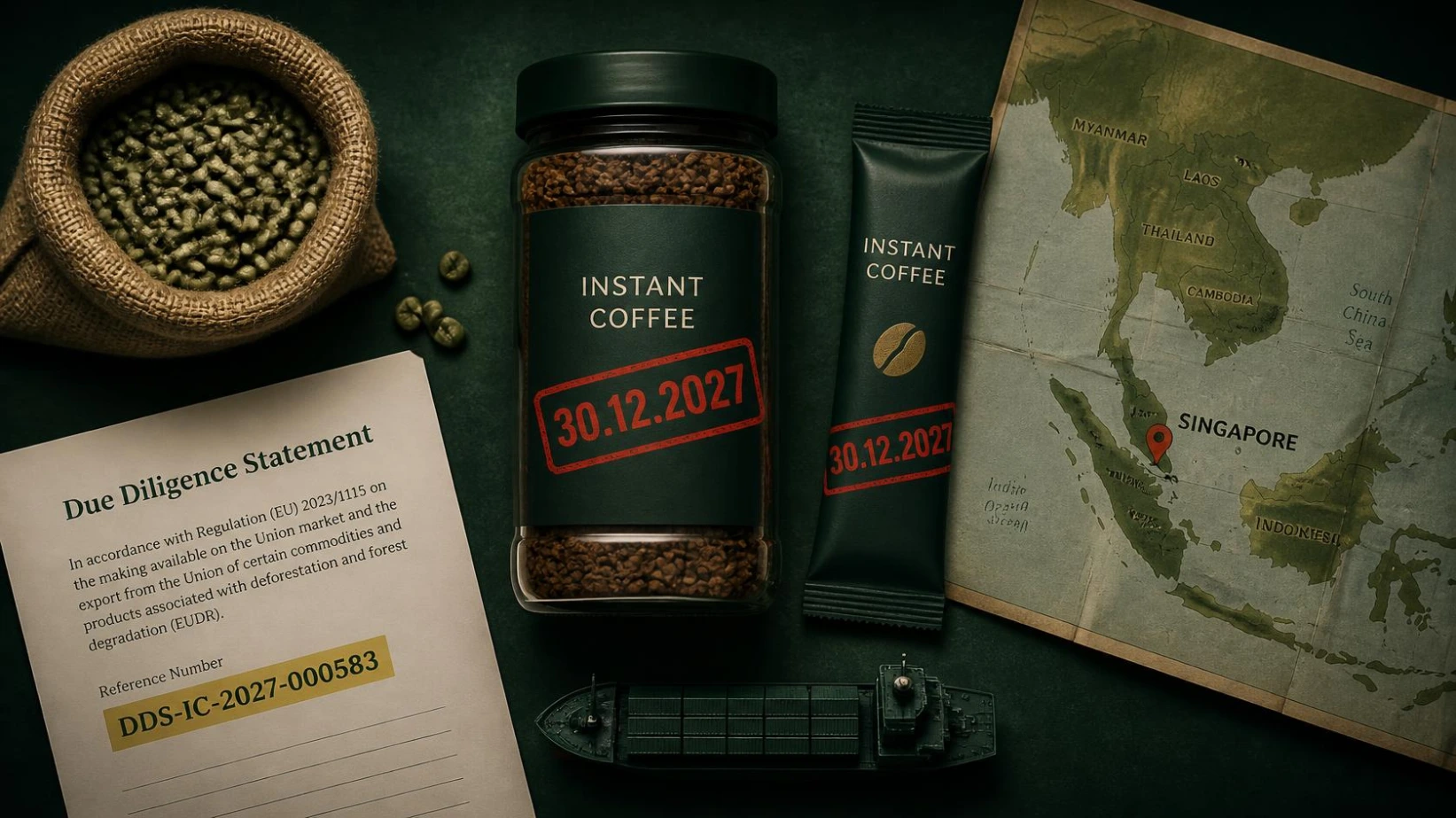
The July 13, 2026 Delegated Act tells a different story. The Commission did not shrink the regulation. It widened it: soluble and instant coffee, previously the loophole, joined Annex I under CN code 2101 11 00. Newly added products get until December 30, 2027 to comply, a year’s grace that acknowledges how much supply-chain work instant coffee demands.
This is the quiet story of Asia’s next compliance wave. Green coffee was always covered. Roasted coffee was covered. Instant coffee, the category Asia dominates, just became the front line, and Singapore, the region’s trading and re-export node, sits at the center of it.
The Numbers That Matter
Metric Value Source
EUDR deadline, large and medium operators Dec 30, 2026 Regulation (EU) 2025/2650
EUDR deadline, micro and small operators Jun 30, 2027 Regulation (EU) 2025/2650
Soluble coffee added to Annex I Jul 13, 2026 (CN 2101 11 00) EC Delegated Act
Compliance deadline, newly added products Dec 30, 2027 EC Delegated Act
Deforestation cut-off date Dec 31, 2020 European Commission
Geolocation requirement GPS <4 ha / polygons >4 ha European Commission
Penalty floor Fines ≥4% of EU-wide turnover Regulation (EU) 2023/1115
Compliance lead time for new origins 4–5 months (GPS + smallholder onboarding) Ad Astra research briefing
Vietnam EUDR risk status Low-risk; ~462k ha mapped Ad Astra research briefing
Nestlé Brazil Araras soluble exports, 2026 +27%, to 20,200+ tonnes, 57 countries Nestlé H1 2026 results
India, soluble share of domestic use ~73% Ad Astra research briefing
Singapore share of Vol 10 audience 13% (top location) LinkedIn analytics, Aug 2026
① The Scope Only Grows. Plan for Instant.
The delay pattern lulled the industry. The scope pattern is the opposite: every revision adds surface. Green, roasted, and decaf coffee were covered from the start. The July 2026 Delegated Act closed the last big coffee gap by pulling extracts, essences, and concentrates of coffee, the instant and soluble category, into Annex I.
The logic is simple: deforestation risk does not disappear because beans become powder. If non-compliant green coffee could be shifted into soluble production, the regulation would regulate nothing. The Commission said exactly that in its rationale.
The consequence for Asia is large. Instant is not a niche here. Vietnam exports soluble at scale, India’s domestic market runs largely on instant (about 73% of domestic use), and China’s soluble capacity keeps growing. Every one of those flows into the EU now carries due-diligence obligations, with the 2027 deadline as the runway.
Four to five months of lead time for GPS collection and smallholder onboarding means the work starts before the year ends, not after.
② Singapore Is the Node Nobody Is Talking About
The briefing’s APAC read is blunt: for Singapore, Hong Kong, and China-origin soluble or re-export flows, the Delegated Act adds real compliance surface. Singapore is the region’s trading and re-export hub, the place where soluble coffee from multiple origins is consolidated, blended, and shipped onward, including to EU buyers.
The operator-versus-trader distinction decides the burden. A Singapore entity that first places soluble coffee on the EU market is an operator with full due diligence and a Due Diligence Statement to file. One that resells product already on the EU market is a trader with lighter record-keeping, but still must retain and pass on DDS reference numbers.
Blending or repackaging in Singapore for EU export leans operator. Getting the classification wrong is not a paperwork error; it is a border block.
The market is already pricing this in. Buyers are including DDS reference numbers in purchase contracts for early-2027 arrivals, and EUDR risk is embedded in Q4 2026 physical trade. Singapore traders who build traceability and geolocation capacity now, while the 2027 clock still has slack, convert a compliance burden into a sourcing advantage.
③ The First Movers Are the Low-Risk Countries
EUDR rewards prepared origins. Vietnam has already been designated low-risk, with roughly 462,000 hectares mapped and a national traceability database in development. That is a first-mover advantage, and one that repeated delays have put at risk as urgency fades.
The lesson transfers to soluble supply chains: the origin that can hand over geolocation and compliance documentation wins the contract, because the buyer’s own DDS depends on it. This is Vol 10’s premiumization thesis applied to compliance. When you cannot compete on price, you compete on proof.
Traceability is becoming the new certificate of quality for EU-bound coffee, and the countries and traders that build it first will capture the premium.
A review clause in April 2026 adds one more variable. The regulation can be adjusted again. The only safe planning assumption is that scope does not shrink.
Colombia: The Origin That Needs This Most
Colombia ships its coffee overwhelmingly as green beans, the same 98%-green export model this newsletter mapped in Vol 8, and every green bag crossing into the EU now carries the same EUDR documentation load.
The compliance test for Colombian exporters is not brand recognition, which is strong, but traceability at the farm level: geolocation for smallholders, DDS references, and the 2020 deforestation cut-off. Colombia’s green-dominant model means the burden lands on the first link of the chain, and the origin that answers with documentation, not reputation, wins the EU shelf.
The Colombian audience that filled Vol 8’s comment section knows this story is coming. EUDR is the tariff wall of this decade, and it is not 12%. It is a documentation bar that decides market access.
What This Means for Brands Entering the EU
Treat instant coffee as EUDR-scoped now. The 2027 deadline is grace, not exemption. Soluble supply chains take the longest to map; start this quarter. Know your entity’s role. Operator means full due diligence and DDS filing. Trader means lighter records but DDS pass-through. Blending and repackaging push you toward operator. Classify before you contract. Buy from low-risk, mapped origins. Vietnam’s 462k hectares and traceability database are the benchmark. Demand geolocation and DDS readiness from every origin supplier. Put DDS references in contracts. Buyers already are, for early-2027 arrivals. Make compliance evidence a contractual term, not a post-shipment request. Singapore is the strategic location, not just a logistics one. A trader or re-exporter who owns traceability infrastructure becomes the partner EU buyers seek.
The Regional Frame: Asia’s Instant Coffee Is the Next EU Battleground
EUDR’s first phase was about green coffee and the big origins. Its second phase is about processed coffee and the trading hubs. Asia dominates instant production, and Singapore dominates the region’s re-export flows. That combination makes this an Asian story, not a Brussels one.
The same logic that pulled soluble coffee into Annex I could reach further down the value chain later. The direction of travel is clear: more products, more documentation, more traceability. The markets that treat compliance as infrastructure, not as a cost line, will set the terms for everyone else.
Closing from China, inbound to Japan
I have watched EUDR move for two years now, from a distant deadline to a line item in physical trade contracts.
The July 2026 Delegated Act is the most consequential shift for Asian coffee since the regulation was first drafted. It catches the category Asia owns, instant coffee, and it puts the region’s trading hub, Singapore, squarely in the compliance flow. The grace period to December 2027 is real, but lead times of four to five months mean the work starts now.
The lesson from Vol 10 still holds, sharper than before: when you cannot sell more cups, you sell better ones. And now, when you cannot prove more, you lose access. Traceability is the new premium.
Ready to map your next compliance move?
At Ad Astra Coffee Consulting, we help coffee brands and trading houses navigate exactly these structural shifts, from EUDR compliance strategy to market entry across Asia.
Book a strategy call or read more in Asian Coffee Insider.